Friday, October 21, 2011
Spelling Test


I was doing the dishes.
Mr. Owl was at work, leading a group for recovering addicts.
Bowery Bird was writing a story.
"Mom, how do you spell heroin?"
I focus on the soap bubbles a second longer, stalling. What do I do? What do I say? Why is she writing about drug use at 9 years old? What have I been missing?! Do I even know my own daughter!!? Deep breath. Game Face. I look up cautiously,
" ....W-hy?..."
"Why are you looking at me like that?!"
What does my face look like? Play dumb.
"What do you mean."
"You know, like--the girl that saves the day."
I blink. To bring my safe-world fully back, I blink again.
"Oh. Right... Oh, 'her-oine'! (chuckling of relief to myself)... I don't know, you'll have to look it up."
Bowery Bird might be spared a few more years, but I'm jaded for life because of my husband.
Friday, October 14, 2011
ASTC Passport to Here and Beyond
 |
I did not know this until I took her to the Bean Museum of BYU which is nothing but.


She was a good sport but I was glad it was a very slow day there workers stared and she cowered inside her hoodie as my 3y/o kept saying "It's OK Auntie, they're not alive."
"I know! That's what bothers me..." my wimpered.
But if taxidermy doesn't freak you out, a membership to a ASTC participating museum is for you.
Association of Science and Technology Centers Passport Program works for, obviously those into science. Get a membership and one and get into smilar museum for free.
This group hasa fair amount of clearly stated stipulations, so do your research. Most museums only participate when your membership museum and home are 90 miles (as the crow flies) from the new one you want to visit. The Passport Program does not apply to special exhibits, big screen shows, or store discounts.
ASTC is probably the most restrictive program, but then, these museums are some of the best.
In Utah these museums participate:
- Clarke Planetarium
- Discovery Gateway
- the Leonardo
- Natural History Museum of Utah
- Thanksgiving Point
Family Scripture Study
 |
You know something is working when you fall out of the habit, and with minimal effort can pick it up again. That's our family scripture study. Finally a method that is doable.
Morning. The kids make their way through a fog to the living room couch, tousled tresses and burritoed blankets. We wait for dad to come out, in the mean time I've taken to pulling out a picture from the Gospel Picture Kit and talking about the story, or grabbing a friend and reading a story. We pass out scriptures from the local shelf. Book of Mormon currently, so it could be military small, large print, faux leather triple, ipod, or Family Edition (my personal fav to decode new words) and someone reads, taking turns. We say a morning prayer and dad leaves for work while children are coaxed out of their blankets and the day begins.
It's simple. It's doable, and we reap the benefits all day.
“Wherefore, be not weary in well-doing, for ye are laying the foundation of a great work. And out of small things proceedeth that which is great” (D&C 64:33).
"The consistency of our intent and work was perhaps the greatest lesson—a lesson we did not fully appreciate at the time."--Elder Bednar in his talk from 2009 Conference regarding scripture study.
Isn't that so reassuring, so simple and doable. In his same talk he speaks of showing love and bearing testimony. Scripture time, on a good day, we can knock out all three--before breakfast is even served!
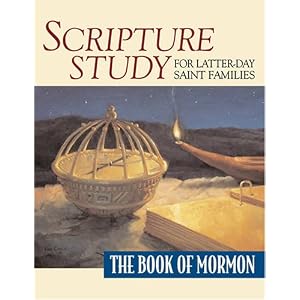
Scripture Study for Latter-Day Saint Families is a nice resource I found, and it is available for other books of scripture. Chapter by chapter it gives short, concise quotes, explanations, object lessons, and visuals that support and expound the doctrine taught. It would make great devotionals or family home evenings, and is versatile for all ages. It is one of those resources that sends you to the scriptures, looking for more.
Friday, September 23, 2011
Ghost Town and a Dry Creek Bed
 |
that was a little boy's explanation for why Mockingbird wasn't in school that day when his mother asked. It's true, and was pretty much how we did Kindergarten.
This time it was joining Mr. Owl on a business trip to St. George, UT. The children and I ended up taking field trips of what once was.
 |
| Silver Reef ruins |

Great stuff, we went home and our library kindly order a children's book for us about Charlie called Rough, Tough Charley. Written in unique, sparse verse this biography also has a map following Charlie's life and travels into the west.
Our hikes took us to Anasazi ruins and up a dry creek bed. The children had to help eachother up 5 foot dropoffs and around boulders and bushes, as I had a baby in a backpack. Besides, someone needed to take pictures.
 |
| Back down the creek bed |
 |
| Anasazi food storage ruins |
I wouldn't recommend this with an 8, 6, 3 year old, and 9 month old in the heat alone, with no reward but red rocks and more red rocks. But Mrs. Magpie hadn't been out in the wild in a very long time apparently. Fortunately children don't know any better, and humored my need to "just go and see what's around the next bend--I promise."

Friday, September 16, 2011
Handwriting Y3
What we have done for handwriting this year, that is transitioning from print to cursive is this:
For learning the letters we did something each day with one new letter
Monday--Draw new letter in the air with hand big. Trace the capital letter I've drawn on writing paper, and write some of her own.
Tuesday--Do the same thing with the lower-case letter.
Wednesday--Combine the letters with words using what letters have been learned so far.
Thursday--Do copywork of some exerpt from readings.
Once this is done for all 26 letters (26 weeks), I copied out several Children's songs (using words, not "song language") onto wide lined paper using 3 lines per capital, and skipping a line in between. Then I put them in clear plastic sleeves in her school binder, with notebook paper in between each.
Now she will trace them with a dry-erase marker (if needed) then copy on her own paper what she has just traced, maybe half a page a day. I know it is recommended to to exerpts from readings, but I found that it takes a lot of concentration to connect letters at first, and knowing what was coming up in short words is more doable--and as side benifit helps us hum our way through at least this bit of school work.
For learning the letters we did something each day with one new letter
Monday--Draw new letter in the air with hand big. Trace the capital letter I've drawn on writing paper, and write some of her own.
Tuesday--Do the same thing with the lower-case letter.
Wednesday--Combine the letters with words using what letters have been learned so far.
Thursday--Do copywork of some exerpt from readings.
Once this is done for all 26 letters (26 weeks), I copied out several Children's songs (using words, not "song language") onto wide lined paper using 3 lines per capital, and skipping a line in between. Then I put them in clear plastic sleeves in her school binder, with notebook paper in between each.
Now she will trace them with a dry-erase marker (if needed) then copy on her own paper what she has just traced, maybe half a page a day. I know it is recommended to to exerpts from readings, but I found that it takes a lot of concentration to connect letters at first, and knowing what was coming up in short words is more doable--and as side benifit helps us hum our way through at least this bit of school work.